

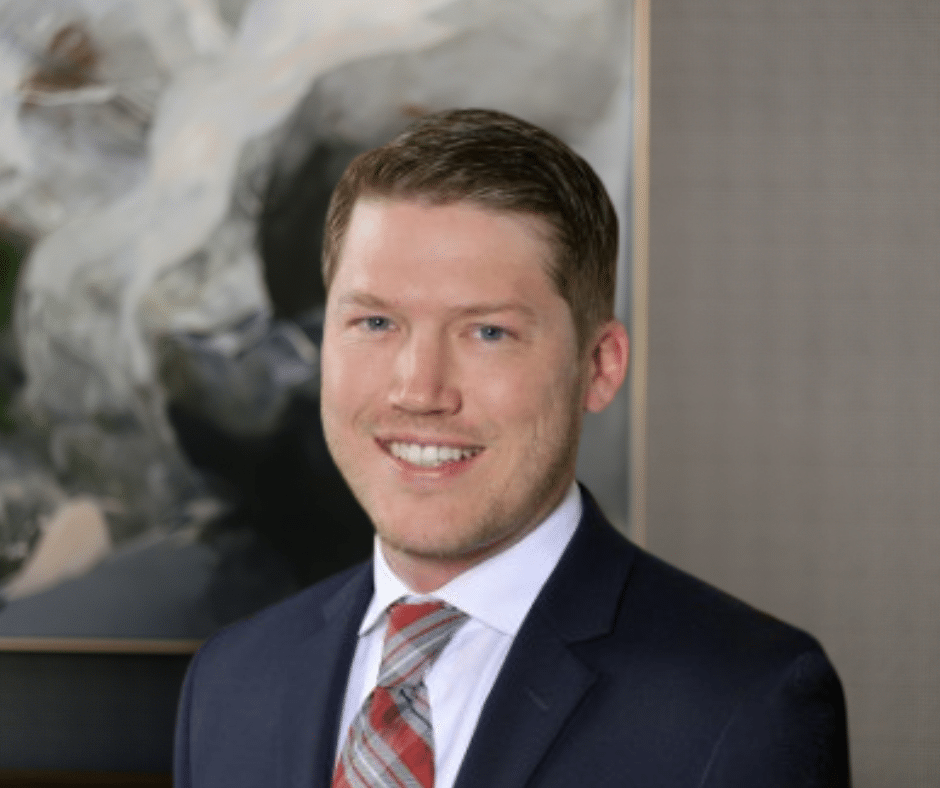
Meet Attorney Joshua C. Grumke
Reviewed by Joshua C. Grumke, Esq.
Attorney Joshua C. Grumke joined the asbestos litigation team at Wallace Miller in 2025. With experience in asbestos exposure law as well as civil defense, he works with compassion and efficiency to make sure that every client gets what they need to take care of their family and loved ones.
When did you first think you might want to be a lawyer?
I always said, “Hey, I’m going to be a doctor.” Then sometime in middle school I cut my leg open and nearly passed out at the sight of a little cut on my leg, and I said, “I don’t think that’s going to happen.”
My uncle was an attorney, so that was alluring to me. I always tell people I went into law school wanting to make a lot of money and I came out with a whole different perspective on things.
What changed in law school?
I was in law school in St. Louis when the Michael Brown shooting happened. It made me look at how the law works and how unfair the system can be. I also read Urban Outcasts by Loïc Wacquant around that time, which talks about how certain categories of people, typically poor people, are marginalized no matter the society.
Both of those put together opened my eyes to why fairness, as imperfect as it can be, is so important to the law. Whether I’m doing plaintiff or defense work, it’s about trying to get the most sensible outcome for both parties.
How did you decide where you wanted to work after law school?
When I came out of law school, it wasn’t the greatest time to be getting a job. I did some work for a smaller firm when I passed the bar and I also worked at a golf course that I’d been working at since I was a teenager. I worked probably seven days a week for two months straight at one point in time because I had to make money. Those student loans don’t go away.
Then I met Laci M. Whitley (now a partner at Wallace Miller) and she was looking for somebody to do asbestos work with her. I worked with Laci for three and a half years, and then in the fall of 2019 I went and started doing defense work. To a certain extent, I didn’t want to get too pigeonholed into asbestos—I wanted to get more perspective. It allowed me to get more courtroom experience, which I knew would be beneficial in the long run.
But then Laci reached out again and put a bug in my ear about going back to asbestos work. I had an epiphany moment when I thought, “Am I going to do this for the next 20, 25 years? What do I really want to be doing?”
What ultimately convinced you to go back to asbestos law?
Over my first stint doing asbestos work, I had gone out on sign-ups. I went out and worked up cases all over the country. The one that sticks with me the most was right before I left. There was a guy who worked at a plant for an agricultural manufacturer and I spent the better part of a year and a half working on his case. I referred to him as my pseudo-grandfather. Whenever we called up, I would update him on the case, but then within a few minutes we were talking about something else. We were within three months of trial and he passed away.
I thought about that, and it was way more meaningful than what I was doing in defense. So I talked to Laci and we went through some things that just made the most sense.
What makes asbestos litigation so important?
The biggest part is how much knowledge was floating around the industry about it, when they were knowingly putting things out there that were dangerous to people. It’s one thing to put somebody in a dangerous position by their own choice. But a lot of these things were done without companies telling people how dangerous it was.
I’ve been to see clients who are working their butts off just to live, yet can’t seem to get a leg up. They don’t have much of a choice to do what they’re doing. To have some companies exploit that and use that to their advantage to keep them in the dark about something that can end up turning around years later and basically suffocating them—that’s not a very good way of doing business, to say the absolute least. I think that’s the biggest part of it all.
How do you talk to people about asbestos exposure, especially when they’re often facing very serious diagnoses?
We’re trying to hold corporations accountable because they put money above people. A lot of people have already confronted the seriousness of the diagnosis. There’s an underlying understanding that we’re doing this for your kids or grandkids, your wife, your spouse, your loved ones. We shoulder that responsibility and say, “We’re going to do what we can to make sure you don’t have to worry.”
That’s the message we try to get across, because people often don’t really care about who did what. They just want to know that somebody’s going to be held accountable and their family will be taken care of when they’re gone.
How do you keep going in cases like these?
You have to look at what the end goal is, knowing that a lot of times it can feel like you’re being asked to grant a dying wish to someone. They come to you and say, “I want to take care of my family, but I need help to do it.” And you strive to do the absolute most that you can to get them that security that will at least give them peace of mind.
You’ve worked with Laci and the asbestos team before. What makes an effective team?
On the people side, it’s a very compassionate thing to be involved in. This isn’t just cutthroat legal stuff—you’re trying to recover money for people, but you’re also dealing with a very delicate part of somebody’s life and something they’re confronting. You have to have that compassion and that patience throughout. You’re working with people who are going to have a lot of bad days, where they’re angry, they’re sad, they’re sick. You have to show up every day with patience for what they’re going through.
And then the biggest thing for the team is to know where everyone is at and work together, because the last thing that somebody who’s confronting something like this wants is to feel like they’re getting thrown around the spin-cycle.
Legal-wise, it’s the efficiency of getting things through. Like I said, for these people it could be tomorrow, could be next week, it could be another year. It’s very important for us to get moving quick on these things, identify exactly where those exposures came from and then move forward. It’s a race that I wish we didn’t have to participate in, but I think it’s a race worth running.
What do clients need to know about their case?
We work for you. So you tell me when you’ve got a problem, you tell me when it’s not going well or if something has changed. You tell me when we need to alter course or update the plan. I’m here to do the job for you. And if I need a kick in the butt, then go ahead and kick me in the butt.
My feelings don’t get hurt easily. It’s hard to do this kind of work if you’re going to be really touchy about things people say to you, especially when they’re dealing with a serious illness. There’s going to be some really bad days when people aren’t very happy with you, and that’s understandable. But I don’t want them to ever shy away from sharing those things with me, because there’s always a nugget of what the real problem is whenever they talk with you.
We work for you. If you put your trust in us, we’re going to do everything in our power to understand what you need and go after it, and hopefully more than that.
Learn more about Joshua in his bio.