

Camp Lejeune Toxic Water
Wallace Miller is not currently accepting new Camp Lejeune cases. However, that does not mean you don’t have a legal claim. We recommend searching for attorneys and law firms that focus on Camp Lejeune lawsuits.
Online directories like FindLaw or Martindale can help with finding qualified legal professionals, or you can contact your local Bar Association for help in your area.
Overview
Injury: Health issues caused by contaminated water at Camp Lejeune
Defendant: U.S. Department of the Navy
Practice: Mass Tort
Latest Update: February 2026 — Department of the Navy continues to review administrative claims as federal litigation continues.
The Department of the Navy is still reviewing the large number of administrative claims submitted under the Camp Lejeune Justice Act. In the federal litigation, the parties are currently focusing on a limited group of cases with “Track 1” injuries, including bladder cancer, kidney cancer, Parkinson’s disease, leukemia, and non-Hodgkin’s lymphoma.
Claimants are waiting to receive more information in the administrative claims process and in federal court. This is due both to the complicated nature of these litigations and process delays in the federal government (the defendant in this case). Backlogs have been caused by staffing shortages due to reductions in the federal workforce and administrative changes, as well as the sheer number of Camp Lejeune cases—currently more than 400,000 nationwide. While these delays are frustrating, they do not affect claimants’ eligibility or their right to pursue compensation, and our team continues to move forward with our clients’ cases.
Every client’s case is different, and many factors can influence the decision to file a lawsuit in federal court after an administrative claim. Our team is actively following all updates from the Navy and federal court and preparing for the next phase of the process. We will continue to share new information as soon as it becomes available.
Case Team

PARTNER
Mark R. Miller

CONTACT ATTORNEY
Jessica Wieczorkiewicz

ATTORNEY
Kristina Anderson

CONTACT PARALEGAL
Rachel Dougherty

PARALEGAL
Gabriela Lopez
Health Issues Caused by Contaminated Water
Service members, families, and civilian workers who lived at Camp Lejeune between 1953 and 1987 may be eligible to submit a claim for injuries suffered as a result of their water consumption and exposure at the base. Studies estimate that one million people were exposed to contaminated drinking water linked to cancer, birth defects, and other serious health problems.
Injury
Water contamination at Marine Corps base Camp Lejeune
First established in 1941, Camp Lejeune is a U.S. Marine Corps base camp located south of Jacksonville. Operating over 156,000 acres, it trains Marines for global deployment and provides housing, logistical support, and other facilities. It remains one of the largest and busiest Marine Corps bases for training individuals in combat readiness.
Toxins were identified in the Camp Lejeune water supply between 1953 and 1987 at three of the base’s eight water treatment plants: Hadnot Point, Tarawa Terrace, and Holcomb Boulevard.
Testing at the Base began in the early 1980s in response to new regulations from the Environmental Protection Agency (EPA) regarding trihalomethanes, chemicals created when water is treated with chlorine. The results were initially inconclusive, with then-unidentified chemicals interfering with the results. In 1982, these chemicals were identified as the dangerous chemicals trichloroethylene (TCE) and tetrachloroethylene (PCE). However, the source of the contamination was not immediately identified. As part of an environmental cleanup program, the Navy attempted to identify contaminated sites at Camp Lejeune in the mid-1980s by testing wells near potentially contaminated sites. In 1984 and 1985, ten wells were identified and removed from service.
During this testing, benzene—another dangerous chemical—was found in a well serving the Hadnot Point water system. That well was taken out of service as further testing identified additional contaminated wells.
The news of contaminated drinking water became public in December 1984 via an article in the base’s newspaper. The Marine Corps held its first press event nearly six months later. The areas affected included the hospital and residential zones, consisting mostly of housing for the families of enlisted personnel and barracks for unmarried personnel. As a result, the individuals most likely to be exposed to the contaminated water were people of reproductive age and young family members.
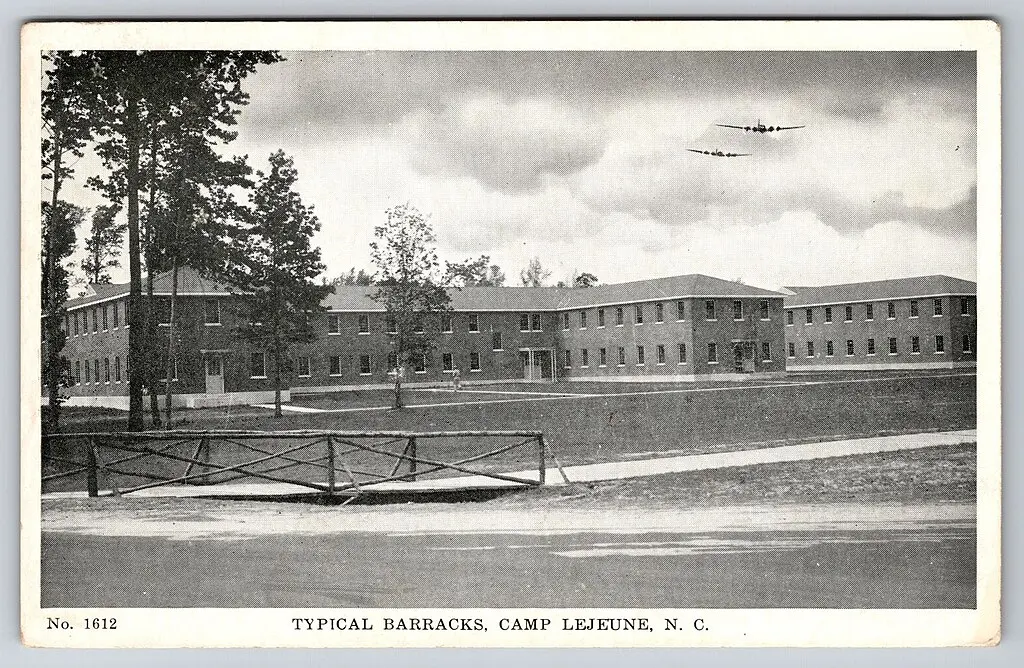
W. R. Thompson & Co., Public domain, via Wikimedia Commons.
Sources of contaminated drinking water
The contaminated wells were affected by sources both on- and off-base. On the grounds of Camp Lejeune, industrial activities and leaking chemical storage tanks led to higher rates of chemicals in the soil and groundwater. The primary dry cleaner used by service members at Camp Lejeune was responsible for the bulk of the contamination off-base, as chemicals used in the processes were not disposed of safely.
The contaminants from both sources leached into wells at Camp Lejeune, which then pumped groundwater into the water systems. Spokespeople from the Marine Corps have asserted that there were no drinking water regulations for these chemicals at the time, as relevant federal regulations were not published until 1987.
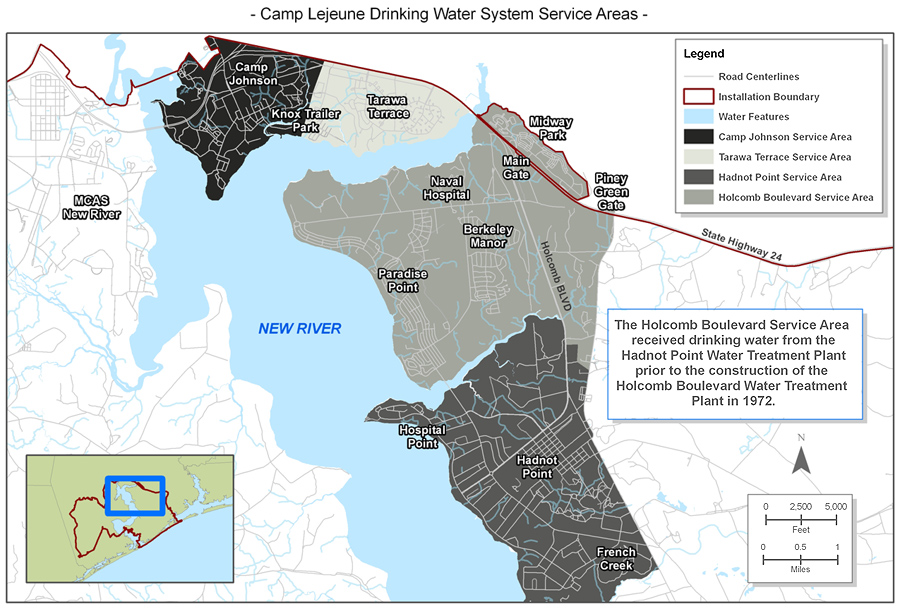
Camp Lejeune’s drinking water systems. Photograph by the U.S. Marine Corps.
What chemicals were found in the water?
The wells at Camp Lejeune were largely contaminated by volatile organic compounds (VOCs), a group of chemicals that includes fuels and solvents. Four core chemicals were identified in the water samples:
- Trichloroethylene (TCE): A clear, colorless liquid mostly used for cleaning metal, including weapons, engine parts, and machinery.
- Tetrachloroethylene (PCE): Also known as perchloroethylene or perc, it is widely used in dry cleaning processes.
- Vinyl chloride (VC): An industrial chemical used to make PVC for pipes, packaging materials, and wire cable coatings, vinyl chloride may result from the breakdown of chemicals including TCE and PCE.
- Benzene: A chemical compound found in gasoline and other fuels, it can be used to make rubbers, lubricants, dyes, detergents, plastics, drugs, synthetic fibers, and pesticides.
Studies also found 70 secondary chemicals in the base’s water, including methylene chloride (a chemical solvent used for paint removal) and toluene (a component of gasoline and other fuels). While it is difficult to estimate what amounts of each contaminant were in the water before testing began, environmental studies have found that levels of toxic chemicals were up to 280 times what is considered safe by the EPA.
Image from the official website of the U.S. Marine Corps.
Health problems linked to chemical exposure
Many diseases and conditions have been linked to toxic exposure, including certain forms of cancer, Parkinson’s disease, and birth defects in children born to those exposed to the toxins while pregnant.
Because of the variety of conditions that may be linked to the contaminated water, diseases are divided into categories. The first contains diseases that have a “presumptive” service connection—those for which there is strong evidence linking their incidence to time at Camp Lejeune. In these cases, it is presumed that diagnosed individuals are qualified to seek justice for their diseases connected to time stationed, living, or working at the base between 1953 and 1987.
Presumptive conditions include:
- Bladder cancer
- Breast cancer (including male breast cancer)
- Esophageal cancer
- Kidney cancer
- Liver cancer
- Lung cancer
- Multiple myeloma
- Myelodysplastic syndromes
- Non-Hodgkin’s lymphoma
- Leukemia
- Female infertility
- Hepatic steatosis (fatty liver disease)
- Miscarriage
- Neurobehavioral effects
- Parkinson’s disease
- Renal toxicity
- Scleroderma
- Aplastic anemia
Many other diseases, illnesses, and conditions may be linked to exposure to contaminated water at Camp Lejeune, depending on the circumstances of the specific case. These conditions include:
- Appendix cancer
- Brain cancer
- Bile duct cancer
- Colorectal cancer
- Gallbladder cancer
- Intestinal cancer
- Pancreatic cancer
- Prostate cancer
- Sinus cancer
- Soft tissue sarcoma
- Spinal cancer
- Thyroid cancer
- Fertility or pregnancy issues and infant injuries, including:
- Birth defects
- Cognitive disability
- Congenital malformation (microcephaly)
- Conjoined twins
- Autoimmune diseases
- Cysts, tumors, and polyps
The likelihood of negative effects due to chemical exposure at Camp Lejeune depends on a number of factors, including when the exposure occurred, the degree of exposure, the duration of the exposure, the nature of the exposure, and the personal habits of the individual.
Photograph by Pixabay.
Plaintiff & Defendant
Am I eligible for a Camp Lejeune lawsuit?
Over a million Marines, families, and workers are estimated to have been exposed to the contaminated water at Camp Lejeune. In order to be eligible for the litigation, the individual must have been:
- Exposed to the water at Camp Lejeune for at least 30 days;
- Exposed between the years 1953 and 1987;
- Diagnosed with a health condition linked to the water contamination.
Many health conditions and diseases have been linked to exposure, including Parkinson’s disease, certain types of cancer, and birth defects.
What is the Elective Option?
In September 2023, the Justice Department and Department of the Navy announced the Elective Option, a new settlement option for Camp Lejeune claims that will allow the government to more quickly resolve qualifying claims. Under the Elective Option, certain injuries caused by exposure at Camp Lejeune are eligible for set compensation amounts. According to a press release published by the U.S. Navy Office of Information, compensation received through the Elective Option does not impact VA benefits.
The amount individuals may receive depends on the injury and the length of the individual’s exposure at Camp Lejeune and are divided into two tiers:
- Tier 1 Qualifying Injuries under the Elective Option
- Kidney cancer
- Liver cancer
- Non-Hodgkin’s lymphoma
- Leukemia
- Bladder cancer
- Tier 2 Qualifying Injuries under the Elective Option
- Multiple myeloma
- Parkinson’s disease
- Kidney disease or end stage renal disease
- Systemic sclerosis or systemic scleroderma
To qualify for the Elective Option you must still first file an administrative claim. The will review the facts of cases submitted and decide whether or not to make an Elective Option offer, a process that currently takes about six months.
For some people, the Elective Option may be a good choice—it provides a way to receive compensation more quickly and ends a long and often tedious process. However, the compensation amounts do not take into account the severity or number of injuries sustained, and so may be inadequate for individuals who are more severely impacted. Even if you don’t qualify for the Elective Option, you may still be able to receive compensation through a legal claim.
The litigation process is complicated, and the Elective Option makes it even more so. Your attorney will work with you to determine the best way to proceed and provide recommendations based on your specific circumstances. Call our office at (312) 667-3143 for a free and confidential assessment of your case in minutes, or fill out our online questionnaire to check your availability.
Landscape
The fight for justice
Plaintiffs in the Camp Lejeune litigation claim that the U.S. Military covered up evidence of water contamination and misled or did not inform those living, serving, and working at the base. As early as 1980, a report to the Navy warned that some well water was “highly contaminated.” Warnings from lab technicians escalated over the course of the next year, and 1982 tests by Grainger Laboratories found solvents in the two largest living areas at the base.

President Barack Obama visits Camp Lejeune in 2009. Photograph by Lance Cpl. Michael J. Ayotte, USMC, Public domain, via Wikimedia Commons.
The Camp Lejeune Justice Act of 2022
In 2022, the Sergeant First Class Heath Robinson Honoring our Promise to Address Comprehensive Toxics Act of 2022 (PACT Act) was passed, granting certain legal claims exceptions from government immunity protections and expanding VA benefits for veterans exposed to toxins like Agent Orange and burn pits.
The PACT Act also included the Camp Lejeune Justice Act (CLJA), which opened a two-year period for military service members, families of service members, and civilian workers who were exposed to chemicals at Camp Lejeune to file claims.
Until August 2024, individuals exposed to toxins can file an administrative claim with the DOJ. If the claim isn’t adjudicated in six months, the claimant can file a civil suit in the Eastern District of North Carolina.
The fight for justice
Despite state pressure, the Marine Corps waited until 1984 to test the wells directly, claiming contamination evidence was inconsistent. Finally, official tests by the Marine Corps in 1984 and 1985 confirmed dangerously high levels of chemicals and a number of wells were closed down.
The EPA warned that Camp Lejeune was a “major polluter” in the 1970s, before the contaminated well water came to light. The base had dumped oil and industrial wastewater into storm drains, buried potentially radioactive materials, and operated a daycare at the former site of pesticide mixing and storage facility. Meanwhile, the nearby dry-cleaning business also disposed of its wastewater, including PCE, in storm drains.
The Marine Corps claims that the water quality at the base was consistent with the standard requirements of the time. However, while the EPA did not specifically regulate organic solvents like PCE in the early 1980s, they did ban harmful substances in water, including hazardous waste.
In 1989, Camp Lejeune was listed as an EPA Superfund site, a contaminated area designated by the federal government for focused cleanup. Ten years later, the Marine Corps began officially informing some former Camp Lejeune residents that they may have been exposed to toxic chemicals.
A criminal investigation conducted by the EPA and the Department of Justice (DOJ) from 2003 to 2005 found that there had been no violation of the Safe Drinking Water Act and no conspiracy to conceal evidence. A report chartered by the Commandant of the Marine Corps in 2004 examined the decision-making at Camp Lejeune and found no violations or coverup—although they did report that the base’s communication with residents was inadequate. In 2007, the Government Accountability Office reviewed actions taken by the U.S. Marine Corps and offered no conclusions or recommendations.
These investigations have drawn criticism because they were conducted by organizations internal to the U.S. government, with some parties alleging a conflict of interest. In early 2012, the Marine Corps sparked further controversy when they asked the Agency for Toxic Substances and Disease Registry (ATSDR), part of the Centers for Disease Control and Prevention, to The Marine Corps claimed that publishing the detailed schematics would pose a risk to the security of the base. However, veterans say that the information has been publicly available for decades. The information contained in the report had been requested by independent scientists in order to conduct a thorough external investigation of the base’s policies and actions.
Later that year, President Barack Obama signed the Honoring America’s Veterans and Caring for Camp Lejeune Families Act of 2012. This act required the U.S. Department of Veterans Affairs (VA) to begin providing health care to eligible veterans for 15 health conditions that may be linked to service at Camp Lejeune. The ATSDR officially linked exposure to chemicals at Camp Lejeune to a number of cancers in 2014.
Despite this progress towards increased support for those impacted by contaminated water at Camp Lejeune, a 2016 court opinion allowed the government to deny claims based on “sovereign immunity,” a legal doctrine under which a state is immune from civil or criminal lawsuits. Despite the pause on Camp Lejeune lawsuits, service members and their families continued to advocate for recognition and compensation.
A rule finalized in January 2017 labeled eight diseases as “presumptive” for service connection, meaning that the VA automatically assumes that these conditions are linked to one’s military service. Individuals diagnosed with these conditions who also served or lived at Camp Lejeune for more than 30 days were provided with VA disability benefits.

Photograph by Pixabay.
Q&A
Is Camp Lejeune still operating?
Camp Lejeune is still operational, with a current population including 38,778 individuals on active duty, 38,769 family members, 3,349 civilians, and more than 18,000 retirees and family members.
According to the U.S. Marine Corps Division of Public Affairs, “Camp Lejeune is in compliance with the comprehensive federal and state laws and regulations established to ensure safe drinking water.” The water at the base is closely monitored for any contamination and checked quarterly for any VOCs. Annual reports available to the public detail the water quality at the base.
What is the average payout for a Camp Lejeune water contamination lawsuit?
In any litigation, there is no guarantee of a settlement or jury verdict in your favor. However, the bellwether trial process can help both the plaintiff and the defense counsel to evaluate the strengths and weaknesses of the case. During this process, both parties can test the legal theories and injuries involved in the case in front of a jury. From there, factors specific to the individual plaintiff’s case, such as medical history, related conditions, and the amount and type of product use, may influence the settlement offer amount.
Since this is a mass tort and not a class action, if a global settlement is eventually reached, the amount each plaintiff receives will depend on their situation. Global settlements—or settlements that apply to multiple plaintiffs—are often divided up into tiers. The plaintiffs in these tiers will receive different set amounts typically based on the type and severity of injury they suffered.
Our lawyers are committed to fighting for the best possible outcome for all plaintiffs involved. They will work with you throughout the process to keep you informed about your case and what is happening with the Camp Lejeune litigation, including the likelihood of a settlement and your potential award amount.
How much does it cost to hire a Camp Lejeune attorney?
Wallace Miller relies entirely on successful settlements to pay our operation fees, so there is no upfront out-of-pocket cost for our clients. This means that you will not incur any kind of fee for your Camp Lejeune lawsuit unless we win your case.
Timeline
February 2026
Department of the Navy continues to review administrative claims as federal litigation continues.
The Department of the Navy is still reviewing the large number of administrative claims submitted under the Camp Lejeune Justice Act. In the federal litigation, the parties are currently focusing on a limited group of cases with “Track 1” injuries, including bladder cancer, kidney cancer, Parkinson’s disease, leukemia, and non-Hodgkin’s lymphoma.
Claimants are waiting to receive more information in the administrative claims process and in federal court. This is due both to the complicated nature of these litigations and process delays in the federal government (the defendant in this case). Backlogs have been caused by staffing shortages due to reductions in the federal workforce and administrative changes, as well as the sheer number of Camp Lejeune cases—currently more than 400,000 nationwide. While these delays are frustrating, they do not affect claimants’ eligibility or their right to pursue compensation, and our team continues to move forward with our clients’ cases.
Every client’s case is different, and many factors can influence the decision to file a lawsuit in federal court after an administrative claim. Our team is actively following all updates from the Navy and federal court and preparing for the next phase of the process. We will continue to share new information as soon as it becomes available.
December 2025
Department of the Navy continues to review administrative claims as federal litigation continues.
Our team continues to monitor the progress of the Department of the Navy as it reviews our clients’ administrative claims, a necessary step before filing a federal lawsuit. In the meantime, Settlement Masters have been appointed in the federal litigation to help oversee the resolution process for bellwether cases. We hope to have more information about a federal settlement in the next few months.
September 2025
Progress continues under CLJA and in federal litigation.
The claim filing deadline under the Camp Lejeune Justice Act (CLJA) passed in August 2024 and the Department of the Navy has been reviewing claims and removing duplicates this past year. There are about 408,000 de-duplicated administrative claims, about 50,000 of which initially appear to qualify for settlement under the Elective Option.
Progress is being made in the federal litigation as well. According to a joint status report filed in the Eastern District of North Carolina in late August, fact discovery (the process in which plaintiffs and defendants exchange facts about the case) is scheduled to conclude this month. Expert discovery (the process through which each side of the litigation obtains information on the other side’s expert witnesses and their opinions) is ongoing. We hope to have more information on the mediation of bellwether cases in the federal litigation and potential settlement criteria in 2026.
All expert witnesses on water contamination and general causation (whether the toxic substances found at Camp Lejeune can cause the injuries alleged by the lawsuit) have been officially deposed (“interviewed”). Expert discovery on witnesses for specific causation (whether the substances actually caused plaintiffs’ injuries) is ongoing.
May 2025
Lawsuits in North Carolina divided into tracks based on diagnoses.
Lawsuits in the Eastern District of North Carolina have been divided into three tracks based on plaintiffs’ diagnoses. Each track will have a different timeline for bellwether trials, or the initial test trials conducted in multidistrict litigation.
The first track will cover diseases strongly linked to exposure at Camp Lejeune, including leukemia, kidney cancer, liver cancer, and non-Hodgkin’s lymphoma. While no trials have yet been scheduled in the Eastern District, attorneys are actively gathering information on the cases in track one.
The court has indicated that they are eager for these cases to resolve. There are currently more than 400,000 administrative claims pending with the Department of the Navy.
April 2025
Claims to be chosen randomly for settlement process.
In July 2024, the judge overseeing Camp Lejeune cases filed in the Eastern District of North Carolina appointed settlement masters (SMs). The SMs’ goal is to work with the parties to set up a framework for a settlement program.
Now, under a new process proposed by the SMs, a random sample of 2500 claims will be chosen from the 500,000 claims that have been filed with the District Court and through the Navy administrative system. These 2500 plaintiffs will each submit a questionnaire that will be used during settlement negotiations. There is no way to volunteer or influence the selection as part of this sample; claimants who are selected will be notified immediately by their legal team.
The Department of the Navy and the Plaintiffs’ Leadership Group have tentatively agreed to this process. They have stated that they are “committed to participating in global settlement discussions in good faith.” If all goes according to plan, the settlement masters hope to announce a global settlement by the end of 2025, although the tentative nature of the agreement means that every aspect of the process is subject to change. Even if a settlement is announced by the end of 2025, additional time will be necessary to implement the program.
During this process, the Camp Lejeune litigation is ongoing. While we hope that the settlement framework leads to progress in the litigation, we will continue to pursue every legal avenue to achieve justice for our clients.
January 2025
Administrative claims continue to be processed under CLJA.
Last year, the Camp Lejeune Justice Act (CLJA) set up a system for filing claims with the Department of the Navy. After the claim filing deadline passed in August 2024, the Navy identified thousands of duplicate claims, or multiple claims filed on behalf of the same person. Since then, they have been focusing on removing duplicates.
In a status report on January 6, 2025, from the federal litigation in the Eastern District of North Carolina, parties reported that there are about 480,000 administrative claims remaining now that duplicates have been removed. The Department of the Navy is also working to launch a new Claims Management Portal to help manage CLJA claims online.
What happens next?

Photograph by Pixabay.
Now that administrative claims have been filed and duplicates have been removed, the next step is substantiation. During this phase, we will send our clients’ medical and military records to the Navy’s portal in order to prove their diagnoses and exposure to contaminated water.
After substantiation, the Navy will have six months to review each case and decide whether to extend a settlement offer. Our firm is currently working to complete the substantiation process and looks forward to receiving more information over the next few months.
December 2024
Plaintiffs in the Camp Lejeune litigation plan to use a recent EPA ruling banning certain chemicals to support their case.
Announced on December 9th, the Environmental Protection Agency (EPA) rules:
- Prohibit the manufacture and processing of TCE (trichloroethylene) for all commercial and most consumer products within one year.
- Institute a plan to phase out manufacturing, processing, and distribution of PCE (perchloroethylene) for all consumer and many industrial uses within three years.
The agency’s press release identified the contamination of water at Camp Lejeune as evidence of the harm that can be caused by these chemicals, even at low levels. Plaintiffs informed the North Carolina federal court that they would be incorporating the ban into their case on December 19th. There are currently about 2000 cases pending in the Eastern District of North Carolina.
September 2024
According to a recently filed Joint Status Report, there are now more than 550,000 administrative claims on file with the Department of the Navy. If a claim is not resolved at the administrative level with the Navy after six months post-filing, then the claimant may become eligible to file their case in federal court in the Eastern District of North Carolina. To date, there have been 2,089 lawsuits filed.
The discovery process continues as the Plaintiffs’ Leadership Group gathers crucial information for the litigation by conducting witness depositions and gathering evidence from the defendant and from third parties via subpoenas.
August 20, 2024
In a Joint Status Report filed on August 20th, counsel for the plaintiffs and defendant provided a number of updates on filings, discovery, and settlement procedures. The parties reported that more than 2,000 lawsuits were filed in federal court in the Eastern District of North Carolina between February 11, 2023 and July 26, 2024, while 546,500 administrative claims were filed with the Department of Navy.
The large volume of claims coupled with a new online portal the Navy implemented have resulted in significant processing delays. The Navy has said that they are working to process all claims into the portal as quickly as possible. From there, plaintiffs’ counsel and their clients are working on substantiating each administrative claim with the necessary proof of injury and proof of exposure to the contaminated water at Camp Lejeune.
Meanwhile, in federal court, both sides continue to gather relevant information on the harm caused by contaminated water at Camp Lejeune. Plaintiffs are working to access information that the government has consistently tried to withhold, including a study on the link between health effects and contaminated Camp Lejeune water by the National Academy of Sciences and data from the Defense Manpower Data Center. The Plaintiffs’ leadership group is also working to provide information on calculating economic damages to the defendant.
May 2024
Since the Elective Option was announced several months ago, the Plaintiffs’ Leadership Group (PLG) has claimed that the Justice Department and the Department of the Navy have made little real progress in extending offers to eligible clients. A claims management portal announced in April 2024 has been plagued by administrative issues and the Navy’s Tort Claims Unit appears to be struggling with the volume of claims submitted. Administrative claims through the Elective Option currently have a submission deadline of August 10, 2024.